Industrial-scale, automated production of worm casting — designed to produce reclamation-grade output for post-mining soil reclamation and circular agriculture. The core move: move the trays, not the machines.
Canada holds enormous tracts of mined and disturbed land where topsoil structure and biology have collapsed. Remediation at scale is mandated — but under-served.
Worm casting is a proven soil amendment in the US and Asia. Canadian agriculture is following — but local awareness and supply remain the barrier.
Existing worm farms are manual or partly mechanised — too labour-intensive and too small to feed industrial off-take contracts reliably.
Ground-level continuous flow reactor. Feeding gantry on top, blade harvest below.
Fully mechanised Pro-Stack — 2–3 beds stacked, gantry & conveyors per level.
Semi-automated modular Refeed system — assembled level-by-level via bisque joints.
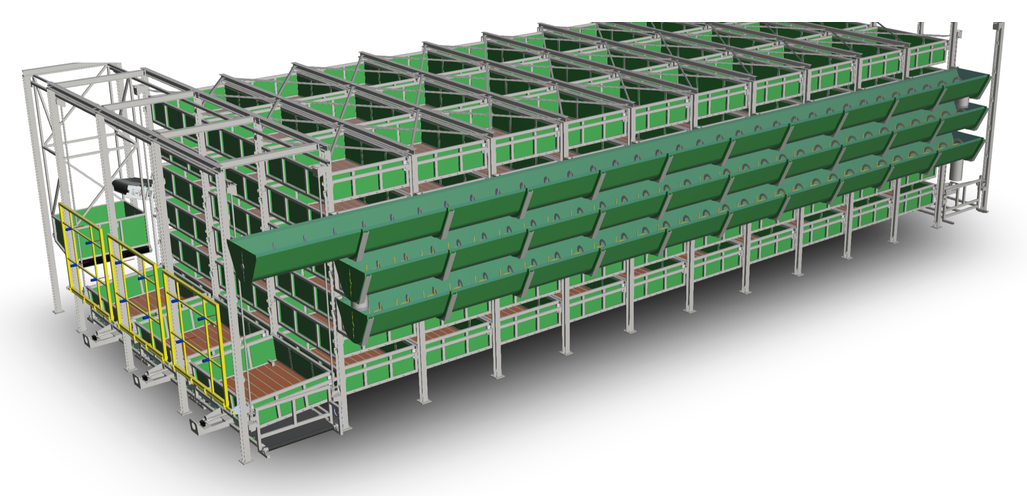
Moveable trays, stationary auxiliary systems. Eight levels, RFID on every tray.
Intelligent automation — biomass scanning & AI tuning. Built for 100+ t/day.
Spreading, cutting and conveying stay fixed; the trays travel to them. That single inversion removes operator aisles, steel and equipment — and is designed to drive the lowest deployable unit cost across our generations.
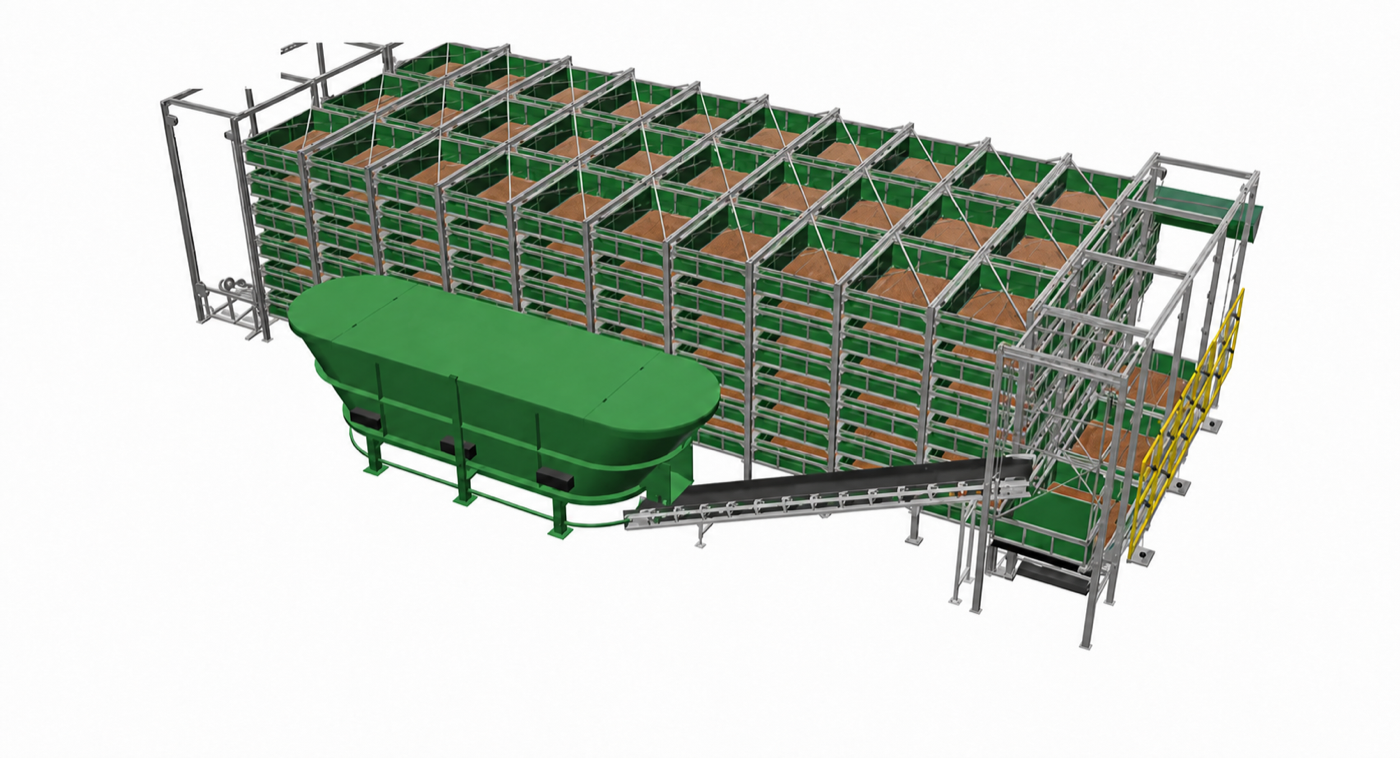
8 stacked levels per tower · 35–40 kg casting per tray per day.
The Soil Recovery Platform is modelled to undercut the earliest manual generation by well over half — the automation and compact footprint are designed to pay for themselves in operating cost.
Contracted off-take needs a stable, low-cost supply. 4G is designed to be the first generation whose economics support industrial off-take without subsidy — to be confirmed against pilot cost data.
| Generation | Cost index | vs. 1G |
|---|---|---|
| 1G Manual | 100 | — |
| 2G Pro-Stack | 83 | −17% |
| 3G Refeed | 67 | −33% |
| 4G Automated | 42 | −58% |
| 5G AI-driven | 33 | −67% |
Modelled relative total cost index (1G = 100) · internal engineering estimate, pending pilot cost data.
We build and operate; partners off-take the output under long-term OEM arrangements. Under the intended model, production is matched to contracted off-take rather than built speculatively — so the off-taker carries no production risk.
Automated, RFID-tracked production co-located with feedstock or demand.
Output designed to be consistent and scalable for soil reclamation and remediation.
Long-term off-take underwrites output up front; distribution and agronomy partners extend market reach.
Casting is sold into reclamation and circular-agriculture channels — not the retail garden market. Four buyer types anchor the demand we're building toward.
Operators with post-mining land under restoration mandates who need reclamation-grade amendment at volume.
Firms executing revegetation and soil-rebuild programs who specify and place amendment on site.
Producers who blend casting into engineered soils and growing media for resale.
Distributors and growers in circular agriculture seeking a consistent, local casting supply.
8-level, RFID-tracked, locate-anywhere production at low deployable cost — available now.
Soil Recovery Platform · 2 t/day
Real-time scanning and AI tuning — targeting healthier worms, higher yield and predictive output.
5G site · ~10 t/day (target)
A target of 100+ t/day at the intersection of agritech and cleantech, rolled out as a locate-anywhere network.
Network · 100+ t/day (target)
Deploy a Soil Recovery Platform unit on a reclamation site to validate output and economics, then structure OEM off-take and the platform scale-up.